Showing posts with label Movies. Show all posts

Tuesday, May 6, 2014

A Truly Scrumptious Imagination

Raised on the 1990s, I spent hours in front of the television watching Sound of Music, Mary Poppins, Peter Pan, the King and I, and also the beloved but slightly less well-known classic, Chitty Chitty Bang Bang.

Thanks to Amazon Prime, I was able to watch it recently for the first time as an adult.  I didn't remember any of the plot, but the songs were as familiar as an old friend.  Somehow, you never seem to forget those tunes from your childhood.  (Sherman Brothers magic.)

The film was released in 1968 and based off of a book by the same author of James Bond.  He wrote it for his son.  The movie's screenplay was co-written by Roald Dahl.

These details stood out to me because, as I watched the movie, I didn't realize that 75% of the movie is spent watching events entirely imagined.

Tuesday, September 17, 2013

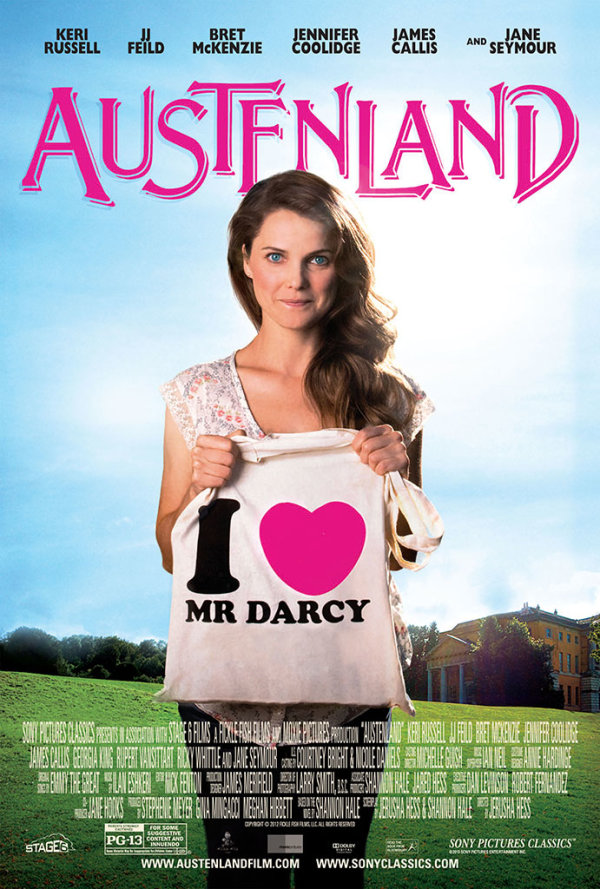
An Austenland Movie Review (from someone who has read the book)


First off, you must understand that I have read the Austenland novel more than once, and it has taken its place amongst one of my favorite novels.  It's not a masterpiece of literature by any long shot, but I appreciated the depth of character in what most would consider a chick flick.  On top of that, it is a fun read.

The Austenland movie came out awhile ago with a limited showing, so I wasn't able to see it until recently.  I write this review with the premise that I am judging the book's portrayal in cinematic form, not as a stand-alone film.

I understand that the move from book to movie requires changes.  There is not a way one can accurately translate a reader's imagination and a character's internal dialogue easily to the screen.  So, I go into the movie understanding that there will be changes and it won't be the same as the book.

Disappointment #1: Use of Satire

While the novel definitely has elements of humor, director Jerusha Hess, best known for Napoleon Dynamite, took that element to a new level and made Austenland a satire.

I understand how she could take it that direction.  In the end, Shannon Hale, author of the novel, is poking light fun at our society's view of romance and women's obsession with Mr. Darcy.  However, taking it to the ridiculous level that Hess does in order to emphasize the satire disregarded Hale's subtle empathy for the Darcy-obsessed.

Wednesday, February 20, 2013

What Bad Books Have That Good Books Don't

What sells books?  

Its the question that haunts writers of all kinds.  Loads of great writing never gets published.  Loads of great published writing never gets popular.  And loads of horrible published writing becomes popular and turns into movies and the like.

Not fair, yes, but that's how it works.

What I have noticed, however, is that a lot of mediocre fiction gets published and gets fairly popular.  Us writers read said book and go, "Ugh!  The writing is horrible!", yet there are still millions of readers (many of whom don't read that much) that have picked up that same story and read it.

WHY?

Thursday, June 7, 2012

So that was......suspenseful

sus`pense [suh-spens]
noun.
a state or condition of mental uncertainty or excitement, as in awaiting a decision or outcome, usually accompanied by a degree of apprehension or anxiety.

Hollywood is very good at the dictionary definition of suspense.  They figure all they have to do is withhold information, and by definition, they have created suspense for their audience.

But suspense is much more complicated than that.  In fact, I feel like good suspense is difficult, even though it seems like building suspense in a novel or a movie should be one of the simpler things to accomplish.

Let's take the movie Snow White and the Huntsman.  (Note, when I go to the movies, I tend to see the film in the eyes of a critic.  So, if you liked this movie, please take no offense.)  While the movie was entertaining, it failed to be suspenseful for me.  Why?


No character development.  In order for us as the audience to care about the "awaiting decision or outcome", we must care about who is going to be the recipients of such an outcome.

When Kirsten Steward is running around in the Dark Forest, we have a hard time conjuring up deep concern for her.  Yes, her mother died, her father was murdered, and she was locked in a castle for half of her life.  But that doesn't create genuine sympathy for the character.  What does?  Back story.  Understanding who she is and what drives her.  If we understand her goals, then we have something to root for.

Why should I worry about the nameless Huntsman when, not only does he not have a name, but we also don't understand why he cares about the Princess or why he's decided to ultimately fight for her in the first place.  After she takes a bite of the poison apple, he stands there emotionally yelling at the dwarfs in his grief, and the audience has nothing to understand why he cares for her.  Last emotion he expressed about her was that she was a liability to him.  Even though he spills out his heart to her before he kisses her (a little late, thank you very much), the information is not there early enough (or shown rather than told) to earn anything.

William, the duke's son, is obviously passionate enough about Snow White to disobey his father, ally with the evil queen's brother, and risk his life to kiss her after he presumes her dead.  But what do we know about their relationship?  Nothing.  All we know is that they grew up together and he playfully stole an apple from her once as a child.

Because we do not care for the characters, do we care if they live or die?  Maybe a little.  They are people, and most people don't like seeing people die.  But in the world of theatrics, a fictional death doesn't mean anything, really.  As a storyteller, whether on screen or written, one must develop character first before the suspense can mean anything.