Showing posts with label Persuasive Writing. Show all posts
Tuesday, September 17, 2013
An Austenland Movie Review (from someone who has read the book)
First off, you must understand that I have read the Austenland novel more than once, and it has taken its place amongst one of my favorite novels. It's not a masterpiece of literature by any long shot, but I appreciated the depth of character in what most would consider a chick flick. On top of that, it is a fun read.
The Austenland movie came out awhile ago with a limited showing, so I wasn't able to see it until recently. I write this review with the premise that I am judging the book's portrayal in cinematic form, not as a stand-alone film.
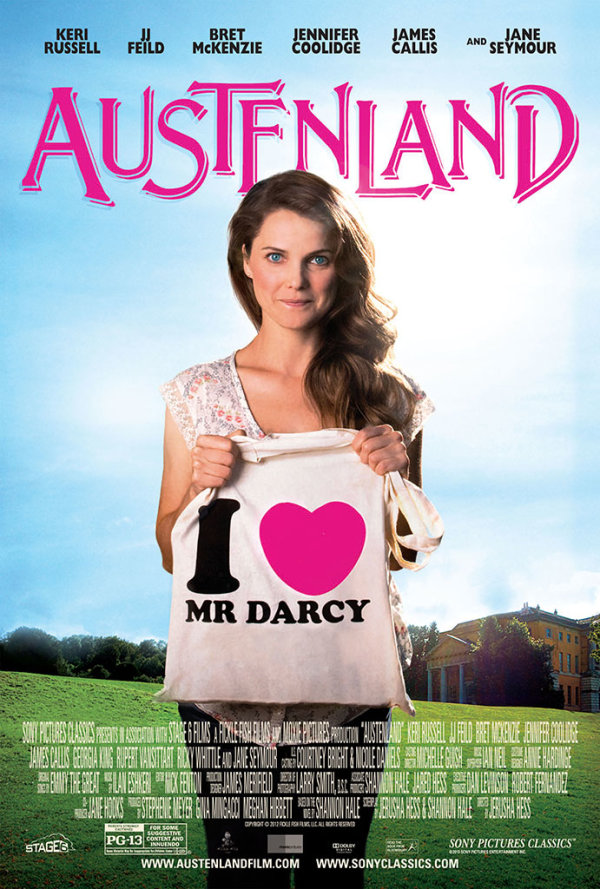
I understand that the move from book to movie requires changes. There is not a way one can accurately translate a reader's imagination and a character's internal dialogue easily to the screen. So, I go into the movie understanding that there will be changes and it won't be the same as the book.
Disappointment #1: Use of Satire
While the novel definitely has elements of humor, director Jerusha Hess, best known for Napoleon Dynamite, took that element to a new level and made Austenland a satire.
I understand how she could take it that direction. In the end, Shannon Hale, author of the novel, is poking light fun at our society's view of romance and women's obsession with Mr. Darcy. However, taking it to the ridiculous level that Hess does in order to emphasize the satire disregarded Hale's subtle empathy for the Darcy-obsessed.
Labels:
Austenland,
Character,
Culture,
Humor,
Jane Austen,
Media,
Movies,
Persuasive Writing,
Review,
Satire,
Shannon Hale,
Story
Tuesday, July 16, 2013
A Call for Christian Artists!
Dear Christian Artist,
For the purpose of this post, I am going to define "artist" as anyone who produces any creative work, such as a painter, a musician, a writer, a songwriter, a movie producer, an actor/actress, a photographer, etc.
You are rare! Did you know that? You are a rare gem in the Christian world. Why? Because in the creative field, there is more freedom. You know this. Your ability to create and to twist and to pull anything you feel like. That is the freedom I'm talking about. And, of course, the world has taken that opportunity, that freedom and used creative works to demonstrate perverted and vile things. Sex, immorality, rudeness, a blurring of the truth, etc. The world has taken the expression of the human self and used it to portray ungodly material. So, the Christians left that world, that creative sector.
For the purpose of this post, I am going to define "artist" as anyone who produces any creative work, such as a painter, a musician, a writer, a songwriter, a movie producer, an actor/actress, a photographer, etc.
You are rare! Did you know that? You are a rare gem in the Christian world. Why? Because in the creative field, there is more freedom. You know this. Your ability to create and to twist and to pull anything you feel like. That is the freedom I'm talking about. And, of course, the world has taken that opportunity, that freedom and used creative works to demonstrate perverted and vile things. Sex, immorality, rudeness, a blurring of the truth, etc. The world has taken the expression of the human self and used it to portray ungodly material. So, the Christians left that world, that creative sector.
Labels:
Change,
Christ,
Christianity,
Creation,
Creativity,
Culture,
Faith,
Gospel,
Idea,
Ideal,
Identity,
Persuasive Writing,
Publishing,
Transitions,
Typecasting,
Writing
Tuesday, April 30, 2013
It Takes Two
As an English major, writer, and human being, I am acutely aware that what you say usually isn't what is heard.
That's usually a problem.
Anyone who's dated know this firsthand. You say one thing, he hears another. That's the issue with communication is that there are TWO people involved. Two very different people with different sets of vocabulary, connotations, backgrounds, upbringings, and slang.
We're not even getting into body language here, just words for the moment.
My belief is that it is the responsibility of the communicator to do their best to ensure that the listener is understanding what is being communicated in the intended way.
Tuesday, April 16, 2013
Porn or Pr0n: What's the Difference?!
One of my friends used to always use the word "pr0n" instead of "pornography" or "porn," and it always struck me as odd. Does switching the letters around and substituting a zero for the "o" really changing anything? People who read what you typed understand that pr0n = porn so there is no difference in meaning. Are there people who really are less offended because one attempted to "hide" the word?
Thursday, November 15, 2012
Persuasive Fiction
I recall a time in high school English class in which we studied "persuasive writing" or "argumentative writing." We were given a controversial topic--often something important like whether taking sodas out of vending machines would really stop childhood obesity--and then were required to write an essay arguing for or against.
I would argue--aha, you see what I did there--that everything we write is persuasive to a certain extent. Even descriptive writing can be persuasive.
I shall define at this moment, like a good English student, that "persuasive/argumentative writing" is not as linear as arguing for or against an idea but rather writing that tries to persuade the reader or make a point.
As a result, my statement that something like, "The light bulb in the room dimmed, then flickered, then went out," can be persuasive doesn't sound as silly. (See? That is why it is important to define your terms.) As a fiction writer, that statement is trying to persuade the reader that the room is spooky or what have you, depending on the context.
A story is persuasive because as an author, whether you do it consciously or subconsciously, you're trying to prove something to you reader. This is often interpreted as the theme of the story.
Therefore, a story is a vessel in which to try and convey your ideas to readers. Albeit a much gentler method than straight out debate, I think it is important as a write to understand the power each individual word/sentence/paragraph has. Each element is an example of persuasive writing and is working together toward describing a bigger idea, which is ultimately a piece of the writer's heart.
I would argue--aha, you see what I did there--that everything we write is persuasive to a certain extent. Even descriptive writing can be persuasive.
I shall define at this moment, like a good English student, that "persuasive/argumentative writing" is not as linear as arguing for or against an idea but rather writing that tries to persuade the reader or make a point.
As a result, my statement that something like, "The light bulb in the room dimmed, then flickered, then went out," can be persuasive doesn't sound as silly. (See? That is why it is important to define your terms.) As a fiction writer, that statement is trying to persuade the reader that the room is spooky or what have you, depending on the context.
A story is persuasive because as an author, whether you do it consciously or subconsciously, you're trying to prove something to you reader. This is often interpreted as the theme of the story.
Therefore, a story is a vessel in which to try and convey your ideas to readers. Albeit a much gentler method than straight out debate, I think it is important as a write to understand the power each individual word/sentence/paragraph has. Each element is an example of persuasive writing and is working together toward describing a bigger idea, which is ultimately a piece of the writer's heart.
Labels:
Argument,
Essays,
Idea,
Language,
Persuasive Writing,
Story,
Writing,
Writing Process
Subscribe to:
Posts (Atom)